Thirty brands, one warehouse, one system that keeps them apart.
Amphora runs on your own server. Every product, pallet, movement and fee belongs to a customer from the moment it enters the system — and every billable moment is captured the instant it happens.
The problem it was built for
Running a third-party warehouse means running dozens of businesses at once: each brand with its own products, rules, carriers and prices. Most operators hold that together with spreadsheets, tribal knowledge, and software designed for a warehouse with one owner. The result is familiar — billable work that never gets invoiced, counts nobody fully trusts, a scramble every time a beauty or pharma client asks which batch went where, and onboarding that takes weeks.
Six differences that matter in a demo
- 1You own it. Amphora runs on your hardware. Inventory, client data and billing never leave your building; it works on a warehouse LAN with no internet, and there is no per-seat meter.
- 2Counts you can defend. Stock on hand is a sum of an append-only movement ledger, not a number someone typed. When a client, an auditor or a recall asks how a count got there, the history is the answer.
- 3Batches keep their dates. Every lot carries its own expiry and packaging version. FEFO allocation honors each customer's minimum shelf life, and expired stock blocks itself from shipping.
- 4The bill writes itself. Receiving, storage, picks, units, rush, cartons — each recorded as the work happens and priced by that customer's rate card. A month's invoice is a sum, not an investigation.
- 5A new client is configuration. Portals, carriers, fees, lot-code templates and SLAs are per-customer settings. Unusual demands become an afternoon of setup, not a development ticket.
- 6Nothing is locked in the UI. Every screen's action exists as a documented REST endpoint with a typed OpenAPI contract — scanner guns, storefronts and integrations use the same API the app does.
How goods flow through it
An ASN and a dock appointment, tolerant of how little you know.
One GS1 scan fills product, lot, expiry and quantity; discrepancies are photographed at the dock.
Directed putaway keeps each customer's stock together and treats cold chain, hazmat and secure cages as walls, not hints.
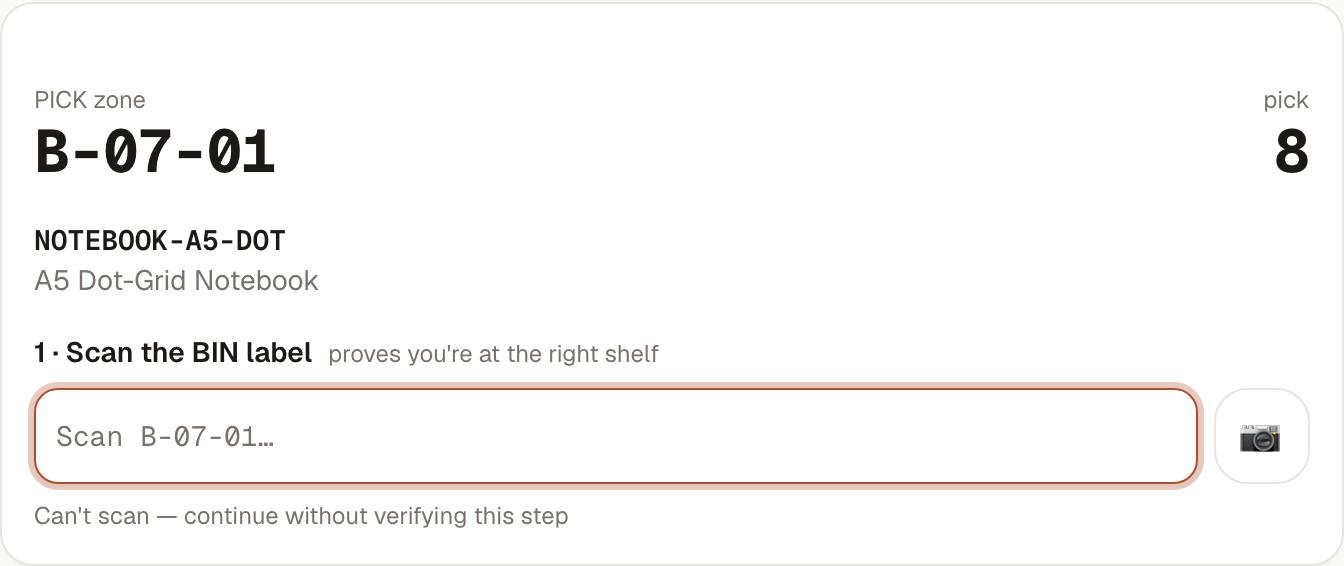
FEFO allocation, a route sorted by the aisle's walk sequence, scan-to-verify at every stop.
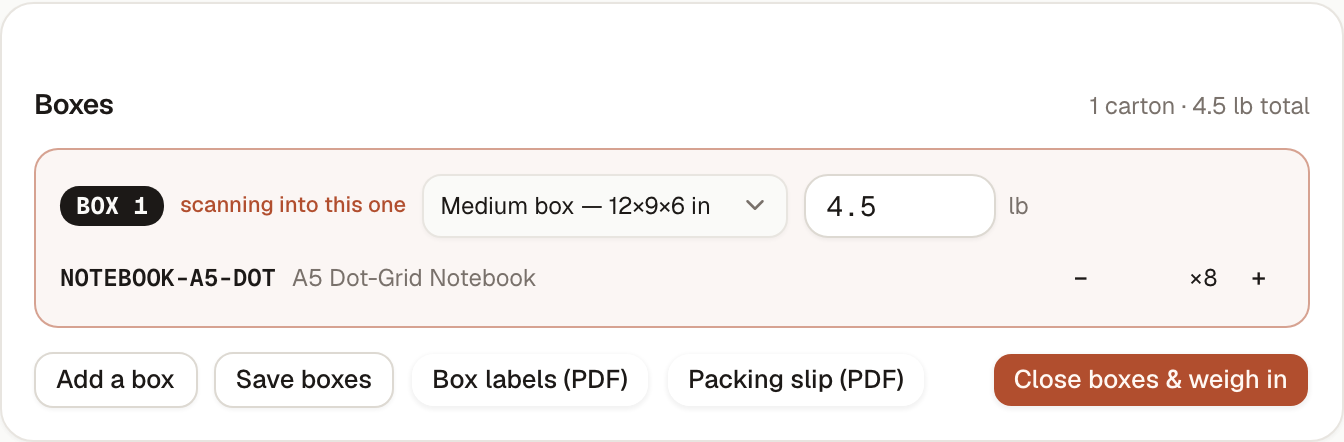
Cartons suggested from your own box catalog, weighed on the scale.
A label from your provider, or a tracking number keyed from the system you already use.
Where it fits
| Operation | What Amphora gives them |
|---|---|
| Beauty & personal care | Lot-level traceability, packaging versions, expiry-driven allocation, recall as a query rather than a project |
| Pharma & OTC | Minimum shelf life enforced at allocation, quarantine and release with reason codes, secure-cage rules, a complete audit trail |
| Retail & apparel | High SKU counts, kits and bundles, batch picking, per-carton shipping records |
| Education & enterprise print | Client-owned catalogs, per-customer portals and SLAs, rate cards that price the work as it happens |
Self-hosted means you look after a server — one SQLite file and an uploads folder to back up, with a one-command snapshot built in. Receiving, inventory, outbound and billing capture are production-grade today; the client-facing portal and the invoice engine are the next two phases. If you want a hosted, storefront-first tool with someone else holding your data, that is a different product on purpose.
See it with your own data
A demo runs on a laptop in minutes with a full showcase world — eight client brands, three weeks of shipped history, live inbound and a book of open orders that reconciles line for line. Bring one of your own client's SKU lists and we'll onboard them on the call.
Book a 45-minute call and we will onboard one of your real clients live — their SKUs, their rate card, their carrier rules — then receive stock and ship an order against it. If it doesn't hold up, you have lost 45 minutes and gained a checklist for the next vendor.
parth@brandboxai.app